Howard's department
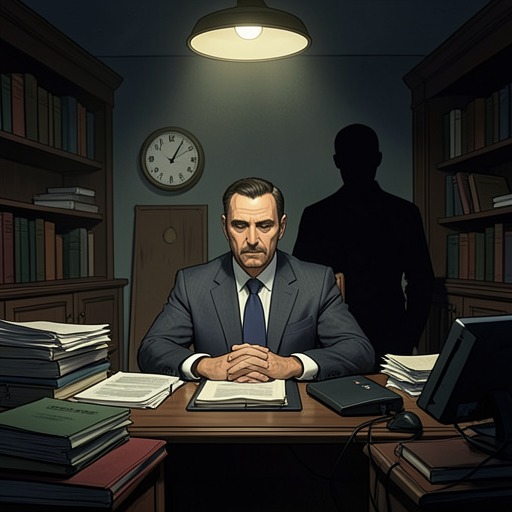
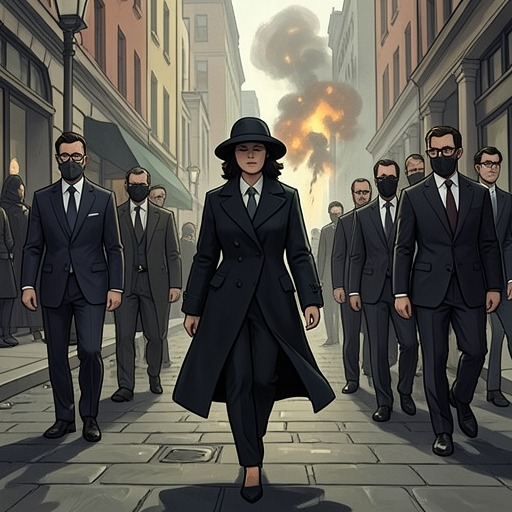
Down Cemetery RoadHoward's department is a secret intelligence organization whose work extends beyond covert action to controlling what the public can know about it. Its reach is glimpsed through the secret detention and testing of soldiers, and made explicit when Howard describes his responsibility for containing the consequences of operations and preventing Michael Downey's story from spreading. The department's defining instrument is therefore not only secrecy around what it does, but the power to make events disappear from the accepted record.
Institutional Identity and Operating Logic
The department is identified through the people who serve it: Sarah Trafford calls them spies, or men in grey, and Howard speaks as someone empowered to decide what happens after a covert operation has gone wrong. He says that the killing of boy soldiers was a crime and claims that those responsible were punished, but distinguishes that violence from the work he regards as his own. His task, as he explains it, is to clean up after events that the public never knew about. The distinction lets him acknowledge the machinery of concealment while presenting its consequences as an administrative necessity rather than a fresh wrong.
The account of a detained soldier gives that secrecy a physical setting. In an unidentified facility, a masked doctor takes blood each day while a nurse brings needles and colored liquids; guards keep the patient chained to his bed. His injuries heal slowly, leaving red weals across his body, and he is taken under blindfold to an operating-theatre-like room for scans in a large machine. The procedures recur about once every three days. Later, the soldier tells Sarah Trafford that he and five others underwent blood tests and whole-body scans, and that the people testing them treated him as an experimental result rather than a human being. These details connect the department's hidden work to the conversion of captive bodies into measurable data, though Howard's later account does not directly establish who ordered each test.
Howard also describes the department's attempt to deal with Michael Downey as an effort to make contact and bring him back into the fold. He says the department did not anticipate that Downey would go haywire, and portrays the agent who attacked Sarah Trafford as having gone rogue, thereby separating the institution from the violence committed in its name. The explanation sits uneasily beside the department's declared role in managing secret operations: it claims authority to contain their aftermath while denying responsibility for actions it says exceeded its intentions.
Cover-up as Policy and Threat
Howard presents concealment not as an occasional expedient but as the department’s regular work. When Sarah Trafford challenges the secrecy surrounding the killing of the boy soldiers, he argues that the public does not want to know what happens in democracy’s margins. His definition of “clearing up” is therefore the management of knowledge: the deaths remain unknown, and the institution decides which truths may enter public life. He claims those responsible were punished, but offers no detail that would let Sarah test that assurance; the crime’s invisibility is itself the condition under which his account must be accepted.
The department’s reach also appears in Sarah’s fear that the deaths witnessed by her and Michael Downey will be erased as another event that officially never happened. A witness points out that Sarah has already seen one death disappear through the actions of spies, and worries that an effort to suppress this new massacre could extend to silencing the surviving witnesses. The exchange makes concealment more than a retrospective cover story: those who can contradict the official version may themselves become targets.
Howard’s proposed solution is to restore Sarah’s ordinary life in return for her silence. She is to put down her gun, accompany him, sign official-secrets papers, and put the events behind her as if they had never occurred. He also offers to help straighten out Mark Trafford’s difficulties, presenting personal rehabilitation and institutional containment as a single bargain. His alternative is not simply a warning to Sarah: if she resists, he says, the department will act against her, Downey, Dinah Singleton, Mark, Wigwam, and anyone else they have contacted. He describes the threatened killings as “major accidents,” turning deliberate violence into the language of chance.
The choice exposes the coercion inside Howard’s reassuring manner. He insists that the department can give Sarah her life back, yet makes that offer credible only by describing the harm it can inflict if she refuses. His confidence that events can be fixed so they never happened links official secrecy to threatened physical elimination: the institution would suppress both the story and the people able to tell it.
Information Control Beyond the Cover-up
The department’s power is shown alongside other institutions that can deny information or turn suspicion into an official account. After the bombing of the Singleton house, Sarah Trafford goes to the hospital seeking Dinah Singleton and presents herself first as a neighbor, then as a friend. The receptionist says she has no information about the child. The exchange leaves Sarah unable to establish Dinah’s condition or even locate her within the hospital, making institutional silence an immediate obstacle before Howard later explains the department’s deliberate concealment of events.
Police pressure gives that uncertainty a second form. Investigators tell Sarah that controlled drugs were found and imply that Joe Silvermann’s work extended beyond private investigations. Simon Smith advises her to accept responsibility for the cocaine, name Joe as its source, and describe herself as a user in need of therapy. He frames the proposed account as a way to redirect attention from the police’s desire to identify someone as responsible for Lizbeth Moss’s death. The episode does not establish that Howard’s department directed the police, but it shows how an official narrative can be assembled from accusation, pressure, and a witness’s forced self-description.
Zoë Boehm urges Sarah to call the police and retract her statement about Joe selling drugs, insisting that the truth must replace the false account. Sarah initially sees this as dangerous because it runs against the advice she has received. Read beside Howard’s later offer to restore her life in exchange for silence, the episode clarifies the wider stakes of information control: facts do not simply disappear; people with power can also pressure witnesses to repeat a version that serves institutional convenience.
Intelligence as Practice
The department’s wider intelligence milieu is also associated with Amos Crane’s distrust of information treated as an answer in itself. At his desk, he works by the glow of a low Anglepoise lamp and a computer screen, regarding the machine as a tool that can offer clues but cannot supply judgment. For that, he believes, an investigator must get close to people and physical reality. This emphasis on contact with human evidence stands in sharp contrast to the department’s secret scans, which reduce captive soldiers to test results; together, the methods expose a tension between knowledge gathered from persons and knowledge extracted from them. The organization’s power lies not simply in collecting information, but in deciding how it is interpreted, what is done with it, and whether the people who bear its consequences are allowed to make their own account.